
This morning, I attended the Seneca English CPD webinar and particularly enjoyed Kat Howard’s discussion on curriculum. I also firmly believe that we are ‘all designers of the curriculum’ because it is crucial that you know what you are teaching, but more importantly, why you’re teaching it.
Our departmental curriculum guru, Deidre, created the skeleton of our curriculum – a model that builds over time and follows a chronological order but makes links throughout. For example, we teach ‘A Christmas Carol’ at GCSE, so it is crucial that our students understand Victorian London and the plight of the poor before they reach KS4. It is vital that we teach this way for our students because the majority of our students simply do not read outside of school and do not have the understanding of literature that they deserve.
Our department then works collaboratively to add the flesh to the bones. Admittedly, this is something we are working hard to improve and we know that the key to a successful curriculum is strong subject knowledge. I have just moved into a new role where I will be focusing on the coaching and mentoring of our team with the aim of improving teaching and learning, and not only improving student outcomes, but ensuring our children receive the best experience every time they are in our classroom. I will discuss this in more detail separately.
Of course, our curriculum route has suffered a major roadblock since lockdown and we have had to rapidly adapt what we are teaching remotely to suit these unusual circumstances. This looks differently for KS3 and KS4, but for Y10 specifically, we have embraced Language for the summer term. We would have been teaching ‘An Inspector Calls’ if we were still at school, but there was absolutely no way we would attempt to do this via Google Meet/Classroom. It is simply not fair for our students to miss out on the performance aspect of this play within the security of the classroom and we’re confident that we can teach this in a short period of time when we eventually return.
When we first closed (but not closed) our school, we sent our Y10s home with a booklet of annotated Power & Conflict poems and knowledge quizzes. We then ‘taught’ these poems over Google Meet and quizzed students on the content while interleaving ‘Macbeth’ and ‘A Christmas Carol’ questions (they had already studied these texts and we wanted to recap their knowledge). We already decided before we left the school building that we would NOT be setting extended writing from home. It is too easy to embed mistakes when you’re not present to guide your students. For some of my classes, I have used my visualiser at home and crafted some ‘What? How? Why?’ responses together to ensure students are still exposed to the process of creating longer form answers, but our primary focus was always to ensure students continued to acquire the knowledge of their anthology poems while ensuring they didn’t lose the knowledge of their other set texts.
Undoubtedly, this can be considered a success. Through Google Form quizzes and Google Meet chat, all of our students attending their English lessons (we have a phenomenally successful attendance record because of the excellent systems that our school already had in place prior to lockdown and have continued to develop since) have demonstrated that their knowledge and understanding has continued to grow. However, this will never be the way that I want to teach English Literature. Poetry is my absolute favourite aspect to teach, and I love nothing more than seeing a student’s reaction to Agard performing ‘Half-Caste’ or to me as I choke my way through Jane Weir’s ‘Poppies’. But, sadly, you get none of this through remote learning. I don’t doubt that my students understand what ‘Poppies’ is about, but they didn’t feel it in the way I’d have aimed for in my classroom.
We then decided that we all needed a poetry break; we’d never teach this cluster in one block anyway. We already knew that Google Forms was working well for us because we can track student answers without the need for endless Docs or photographs of work in exercise books and it doesn’t increase workload unnecessarily.
One of the major issues we have had over the last few years is our students being unable to form their own opinions on a text. This undoubtedly stems from a previously poor curriculum that was focused on teaching to the exam (before my time) and is something our new curriculum is designed to target but is going to take a few years to filter through the year groups. My thinking here was that we could use this time at home to expose students to various fiction extracts and non-fiction texts linked by their key concepts. We began with Atwood’s ‘The Blind Assassin’ and linked the theme of suicide to an article about mental health issues during the pandemic. Forms enables us to pose questions that explore key language and structural ideas so that students are analysing without even realising it.
Example:

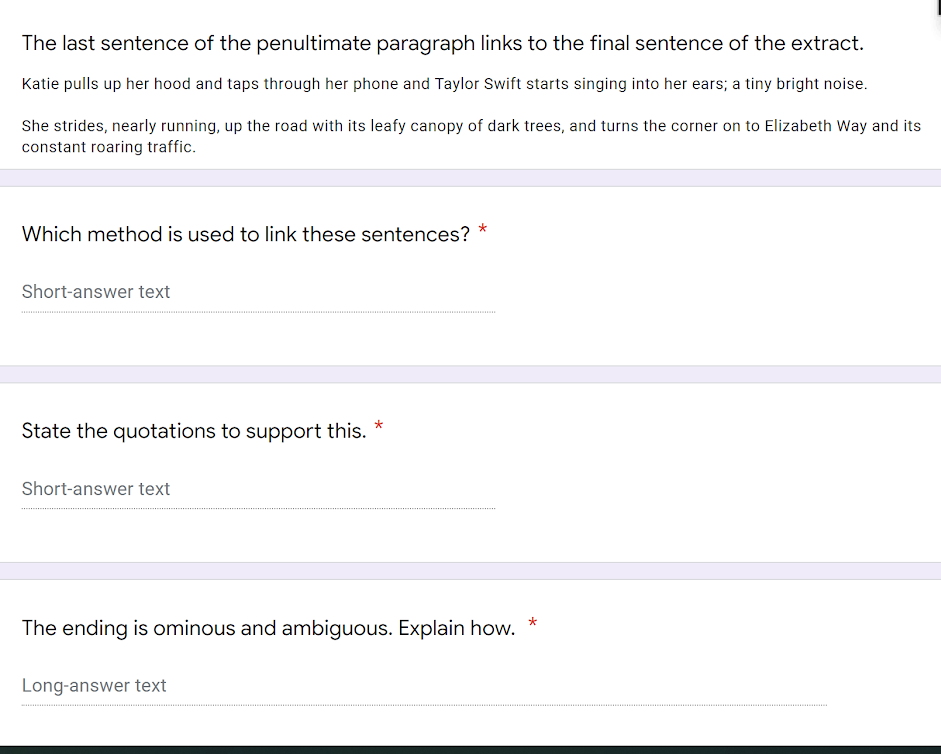
We’re now embracing the BLM movement because it is something we have the opportunity to explore and discuss through our subject, but also, our students are keen to share their opinions on what is going on in the world right now. Many of our children (from an area that is not culturally diverse) form opinions on matters that they are ignorant to and we do not shy away from exploring our heritage and ancestry throughout the curriculum when we’re in school. Even remotely, it is our duty to ensure our students are offered the knowledge that is required to help them to make an informed opinion.
What I’m most proud of is that we’re not only preparing our students for their Language exams next year in unprecedented circumstances, but we’re exposing them to a range of perspectives and ideas and providing a platform for them to be able to discuss and critique these. Our students are literary critics, after all, and this shouldn’t have to stop just because we’re teaching remotely.
While I understand that topic-based subjects will need to address the gaps created during remote learning, we have prepared for a ‘recovery curriculum’ without even realising it. Once again, the beauty of our subject enables us to adapt what we’re teaching to suit the current climate.
I wholeheartedly agree with Kat Howard when she says that ‘a recovery curriculum [in English] is just what we do best: teach really well’.
Recent Comments